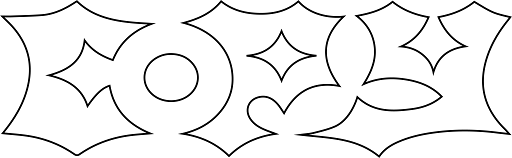

A work in progress by Ben Amos Cooper
Glimpses of a Dream
An interview with the Dead Hand Programme.
By Davis Dunham
3.8.2026
Artist Ben Amos Cooper, who goes virtually by the username The Dead Hand Programme, draws, animates, and scores digital shorts that exist somewhere on the spectrum between dream and nightmare, find a righteous home in doom but not gloom, and appear quite handily in 9:16 aspect ratio, for your scrolling pleasure. Writer Davis Dunham asks Cooper about the method and madness behind his work.


Cooper, and Cooper at work
Interviewer: First off, a little biographical information. Where and when did you grow up? It sounds like you’re an artist in many ways—animator, director, musician—which you seem to do with a level of specialty. I’m curious about when you became conscious of your impulse to express yourself, if you remember.
Cooper: I was born in the late ’90s on the west coast of France to English parents. My dad is a punk street performer and my mum was a full-time parent, so creativity was always part of daily life.
I grew up surrounded by pens, paint, instruments, and all sorts of materials, so expressing myself never felt like a big decision, it was just what I did. Creating and performing was always a way to focus and calm myself, and I think that environment shaped my imagination more than any single moment of realization.
It seems you’re inspired a lot by dark fantasy. With the amount of work you put in to your stop-motion animations, I’m assuming you find at least some joy in the job of producing them. How much of a role would you say the fact that you’re creating dark fantasy plays in enjoying yourself? Are you a fan of movies like Legend, The Dark Crystal, Pan’s Labyrinth, etc.? What kinds of music?
It’s funny, because when I started making these animations, I didn’t actually know what I was making. I just started one day and I naturally went toward this dark, dream-like atmosphere.
I’ve always loved Terry Gilliam’s animations, or stuff like Noggin the Nog, or Noel Fielding’s animations in the Mighty Boosh, but the films you mentioned, Legend, The Dark Crystal, Pan’s Labyrinth, I didn’t actually grow up with. Out of those, I’ve only seen half of Legend (and although I like the retro aesthetic a lot, I didn’t manage to get into it, I’ll have to try again). It was only when people started telling me my stuff reminded them of that universe that I realised I’d unknowingly stepped into “dark fantasy.”
But I’ve always been fascinated by and drawn to this kind of dark imagery. I’ve also always had very wacky dreams, and I’d say that making these animations is a sort of way of bringing them to life, and I get a lot of satisfaction out of that.
Music definitely plays a role in the atmosphere of what I make. I got into music really young, making little songs on GarageBand. My older brother showed me tons of bands growing up: metal bands with medieval aesthetics, but also Sisters of Mercy, The Cure, Siouxsie and the Banshees, Black Sabbath, Electric Wizard. As a teen I got into Tool. All these bands had a very dark aesthetic, which appealed to me so much, and I got really obsessed with a lot of those bands’ music videos and album artwork.
So I didn’t really start with dark fantasy in mind. It came from dreams, from instinct, and from whatever was going on in my head. The fact that it lines up with dark fantasy and that people connect with it is great, and I’m happy if it means more people see the work.


Hands at work
Congratulations on stumbling across the dark fantasy aesthetic in perhaps the coolest way possible. I’m a huge fan of The Cure and some of the other bands you reference, and now that you mention it, I totally see the connection. In addition to people (like me) assuming a relationship with dark fantasy movies, do you also find that people see these medieval, metal bands’ influence in your work? I’m curious about your feelings regarding people assigning a lineage to your work that you weren’t even aware of.
Yes, I think people notice those influences. I’ve always been drawn to medieval imagery, castles, armor, medieval iconography, and demonic themes—and I do love a lot of metal, though I wouldn’t call myself a metalhead per se. Some of those influences were intentional, and it’s really interesting to see how people pick up on them in ways I hadn’t expected.
Your reference to music got me thinking. In some ways, your animations have a music video-type quality to them—conjoined by aesthetic and feeling, though not necessarily plot, as you reference earlier. Combined with your experiences across cultures—French, English, Irish, Austrian—and with mythology, this makes a lot of sense. Out of curiosity, do you ever see yourself breaking from this and producing something with an explicit plot, like a scripted short? If so, do you think your vignettes are moving you towards that?
Right now, I’m more interested in atmosphere and feeling than in telling a straightforward story, which is probably why the work feels closer to music videos. That said, I’m not opposed to narrative at all—I could definitely see myself making something more explicitly scripted in the future. A lot of people have asked if I’d make a video game one day, and that’s something I’d love to explore as well. In a way, these vignettes feel like a space to experiment, and they might naturally lead me toward more structured storytelling down the line.
I’m interested in hearing some details from your process. For an animation of about one minute, how long does production take? How does the work split across physical animation and digital editing? Do the physical and digital processes affect each other (e.g., do you choose certain materials because they create better images/videos to work with on the computer, use a certain program or tactic on the computer to highlight physical qualities of the animations, etc.)?
The time it takes really depends on a lot of things. First, even though my animations are more a “vibe” than a clear story, I have to storyboard them. Then it’s the designing and making of all of the moving parts that takes the longest, so if there are a lot of different elements it can take days or even weeks. As for animating, sometimes I do actual stop motion where I move elements by hand, but a lot of the time I scan all of the moving parts and animate in Photoshop. In my workspace on the screen, I’ll rebuild, let’s say, a character, and create a frame animation, moving a hand or an arm or whatever for each frame. It’s basically the same as stop motion but I don’t have to have a setup and lighting. I can just work directly in my computer, which is not always my favourite thing to do, but as someone who moves around a lot it just makes things simpler. Once I’m happy with that, I’ll save it as a video with a transparent background and bring everything together using editing software.
Even if a lot of things are animated digitally, everything is drawn and cut out by hand. I mainly use wax crayons because they are relatively cheap and the colours are very vibrant, so it’s easy to touch up on the computer. Crayons also have an amazing, imperfect texture that I find works really nicely on the screen.
Do you think the mode of production affects the story you eventually produce? As I mentioned when I first reached out to you, I wrote a serial novel over the summer, which included printing and assembling all the copies to be mailed using my poor little inkjet printer. The transfer between physical and digital media was on my mind, and the plot of the book ended up being about dueling heists to gain access to the last store of non-digitized documents in a high-security facility before they could be scanned and destroyed. Are there qualities to planning, drawing, capturing, and editing your animations that influence the content like this?
Yeah, the process definitely influences what I end up making. I don’t really separate the “story” from the way I’m physically making it, they kind of feed into each other. Since everything is made of paper and is fragile and lightweight, the animations end up feeling that way too. I think the texture of the paper and wax is what gives them that sort of dreamy atmosphere. I plan things, but not too much, because it’s only once I start gathering all the elements and begin animating that I get a clearer idea of what it’s actually going to look and feel like. I think that’s also why I naturally gravitated toward this almost whispered, melancholic style of narration. The universe of the animations has a strange mix of feelings: it’s a bit creepy, but somehow calming; colorful, but with a kind of sadness to it. So yeah, the content really comes from the process just as much as from anything I imagine beforehand.


Cooper makes both predator and prey
You get at least a little traction from those who could unflatteringly be called the artificially unintelligent, who don’t tend to appreciate the process of production as much as we do. How much of this is intentional? How do you feel about engaging with a group of people that likely will not appreciate your work for the sake of views? Do you find that this garners more attention from your fans or your detractors?
I actually find most of it pretty funny. I’m pretty sure a lot of those comments come from iPad kids (at least I hope so, because if they’re adults, that’s just a bit sad). But surfing that whole anti-AI (anti-generative AI) wave has brought in far more people who support my work than people who hate on it. The negative reactions help the posts reach the people who really care about handmade things, and it creates a discussion. What bothers me (apart from the countless horrible implications behind generative AI) is the impatience of a deeply capitalist society. People need things instantly, and I think the feelings of satisfaction and accomplishment are in peril. It’s really important for younger generations to experience that feeling. If what I do can give even a small push in that direction, then I’m happy.
Finally, is there anything I haven’t touched on that you want to talk about?
I guess I could add that creating this imaginary world is a way for me to escape reality for a bit. I’ve always had wacky dreams, and a lot of what I do comes from trying to translate those dreams into something people can actually see.
As a kid, I was fascinated by spirituality, even though my parents weren’t religious. Churches, abbeys, castles, graveyards, and anything tied to myths or death pulled me in.
Before music really took over, I was obsessed with films. I used to build cardboard knight armor, spraypaint it silver, and film friends in the woods. No real story, just swords, fake blood, and creating our own worlds.
Growing up between cultures also shaped me a lot. Everything at home was English, and living in France, then Ireland and Austria, exposed me to myths, poetry, and landscapes that now blend together in my work.
If you want to see more of Ben Amos Cooper’s work, you can find it online at @theeedhp on TikTok and @thedeadhandprogramme on Instagram. Commissions are open.