
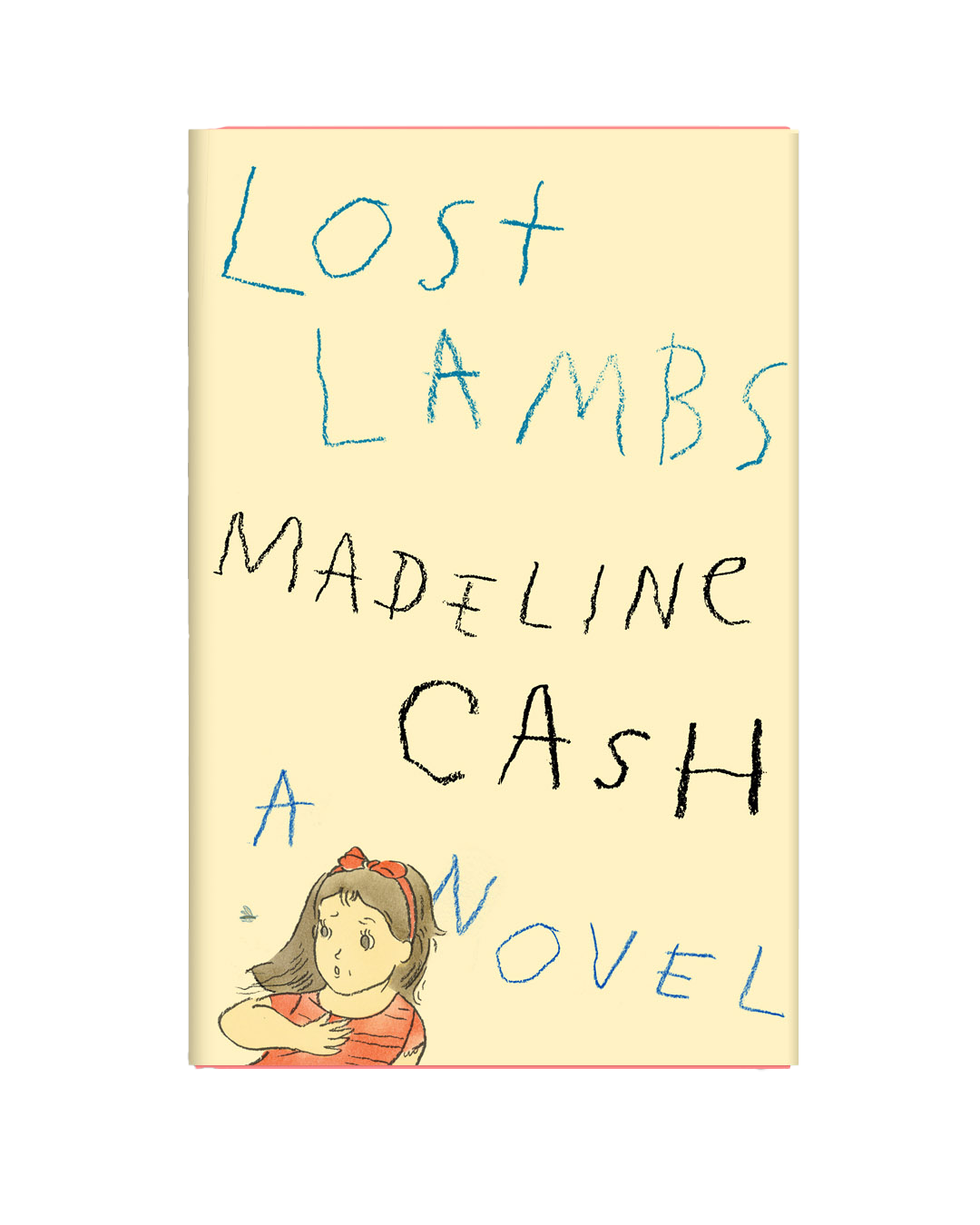
Lost Lambs by Madeline Cash (Farrar, Straus and Giroux).
Capitalism, Terrorism, Polyamory, Oh My!
A Review of Madeline Cash’s Lost Lambs.
By Theodore Heil
1.12.2025
Following the release of her debut short story collection, Earth Angel, Forever Magazine’s Madeline Cash has written a novel of betrayal, religion (and its extremism), and the seemingly neverending torture of being in high school. Marking her departure from the short-story format, Lost Lambs shines as a novel—in both senses of the word—due to Cash’s irreverent and self-referential voice, maintaining a hold on what makes her stand out as a contemporary author.
Lost Lambs follows the trials, triumphs, and tribulations of the Flynn family, a prototypical nuclear unit living on the edge of a small city in California. Bud, the patriarch, works for Alabaster Harbor™ and its CEO, Paul Alabaster, who lives behind the wrought iron of a gated community, in a foreboding mansion that is (nearly) impossible to reach. Paul Alabaster himself can only be reached with concerns about the environmental impacts of his business through a comment form on his website—he’s the kind of person who finds you. Bud has a wife, Catherine, and three girls: Abigail, Louise, and Harper. The girls attend Catholic school, guided by a coterie of nuns and one Father Andrew; Catherine is a homemaker, albeit the untraditional kind. The family is broken open when Catherine, nostalgic for her youth and her life before Bud, suggests opening the marriage—the call of polyamory has sounded off into the suburbs. Through the crack, we’re able to peer in and see the idiosyncratic absurdity of their lives: Abigail’s obsession and insecurity with her veteran boyfriend with IBS, “War Crimes Wes”; long-time romantic Louise’s budding religious extremism brought on by her online boyfriend, Yourstruly; and precocious Harper’s search for a conspiracy everywhere. All of this is notwithstanding Bud’s tragic response to his changing marriage, which involves sleeping in his car and elaborately fantasizing about homely women.
To the merit of Cash’s voice, she is able to do a lot with this varied cast. Though it’s apparent that she primarily writes in short form—the novel’s exposition reads less like scene-setting and more like a story with characters loosely fitting together—her departure from her comfort zone begins to make sense by the story’s middle. The vagaries and general obscurity of why these details matter become not just apparent but deeply poignant. There’s a part of me that wants to compare her voice to Jennifer Egan, or Patricia Lockwood, or even David Foster Wallace, but that feels too much like saying this book is written about “the present moment,” which it is and isn’t. Rather, Cash’s voice examines its subject material as equal parts sensical and not, magnanimous both in its approach to telling the story and giving all the details, no matter how silly. It feels similar to The Virgin Suicides, too, but if the Lisbon sisters were treated as slightly more intrepid. What I mean to say is, like teenagers, this book is multifaceted in a way that is surprising but shouldn’t be. Unlike high schoolers, it knows exactly what it is. It seems kind of ridiculous and choppy, but intentional, in the way that an asymmetrical bob can be chic on the right person. Cash wears her voice on her sleeve, cultivating something wholly unique in a narrative that is oftentimes held together by the funny, seamless chapters bleeding into each other like literary slapstick or a variety show (throughout the novel, the church is infested with gnats, and Cash likewise transforms all the “nat-“ words into little annoying bugs [gnatural, extermignate, etc.]).
These various bleeding neuroses and passions of the characters emulsify leading up to the novel’s climax, which is just as funny as its build-up. There’s one chapter, breaking up the rising action and the comedown, that is entirely a dialogue between Harper and her father, which is just the kind of surprise a book like this sets you up for so close to the end. But hidden in these surprises and the chaos that explodes in the aftercare following a billionaire’s party, the emotions and depth of Cash’s characters begin to take shape and become wholly comprehensible, even bizarrely human.
Poignant moments of the Flynn girls interacting with their family and with their inner selves reveal that their flippant attitudes stem from the innocence that comes with feeling that you’ve seen the world. Their wisdom betrays their naivete in complex moments that effectively balance a broader search for meaning and Cash’s surreal architecture of California not in the far future but in the now: vacuous, disconcerting, and morally and spiritually abandoned. Harper retreats into the wilderness, which forces her to reckon with the aspects of herself that are changing and will continue to change, morphing with time and, disconcertingly, age. Louise can’t seem to capture anyone’s attention, so she turns to religion and then small-scale domestic terrorism. Abigail is popular, pretty, and gets the attention of all of the boys at school, but this comes at a price: she’s held back by her rigorous judgements of others, making her just like her mother. The main tension between our apparent “heroes”—the Flynns—and “villains”—autocratic CEOs and their yes-men—are not readily apparent differences like class, social status, and the various anti-social behaviors afforded only to the uberwealthy, but the differences between those who never want to grow up and those who are doing so quickly and wildly. Cash is able to balance these tricky scales of irreverence and sincerity that manifest in all successful comedies regardless of subgenre: that of puncturing self-awareness and self-criticism. Comparison to other writers—even her peers—is fraught, because Cash’s characters are probably unlike anything you’ve read before. Her novel is funny because the world is slowly ending and the only things you seem to have control over are the Herculean tasks of finding not just yourself but also a boyfriend who isn’t a terrorist.
It’s during the climax itself that Cash’s vision seems to fully crystallize, her characters exploding with truth. What is left after conspiracy, kidnappings, cult meetings, affairs, religious reckoning, and a failed attempt to suicide-bomb an inner beauty pageant is that nobody is perfect, even if they are on the outside. In fact, you’ll be loved for your imperfections no matter how off the rocker you think you really are, and your family will always be there for you no matter what shape that family might take—related or otherwise, polyamorous or not. At the center, it’s not youth that is the most difficult to keep in your life, but true, unconditional love.