2025 Favorites: Literature
Pre-postpartum feelings, the California Zephyr train, a harrowing descent into the echoes of political violence, and more.
By COPY
12.15.2025
Noa F
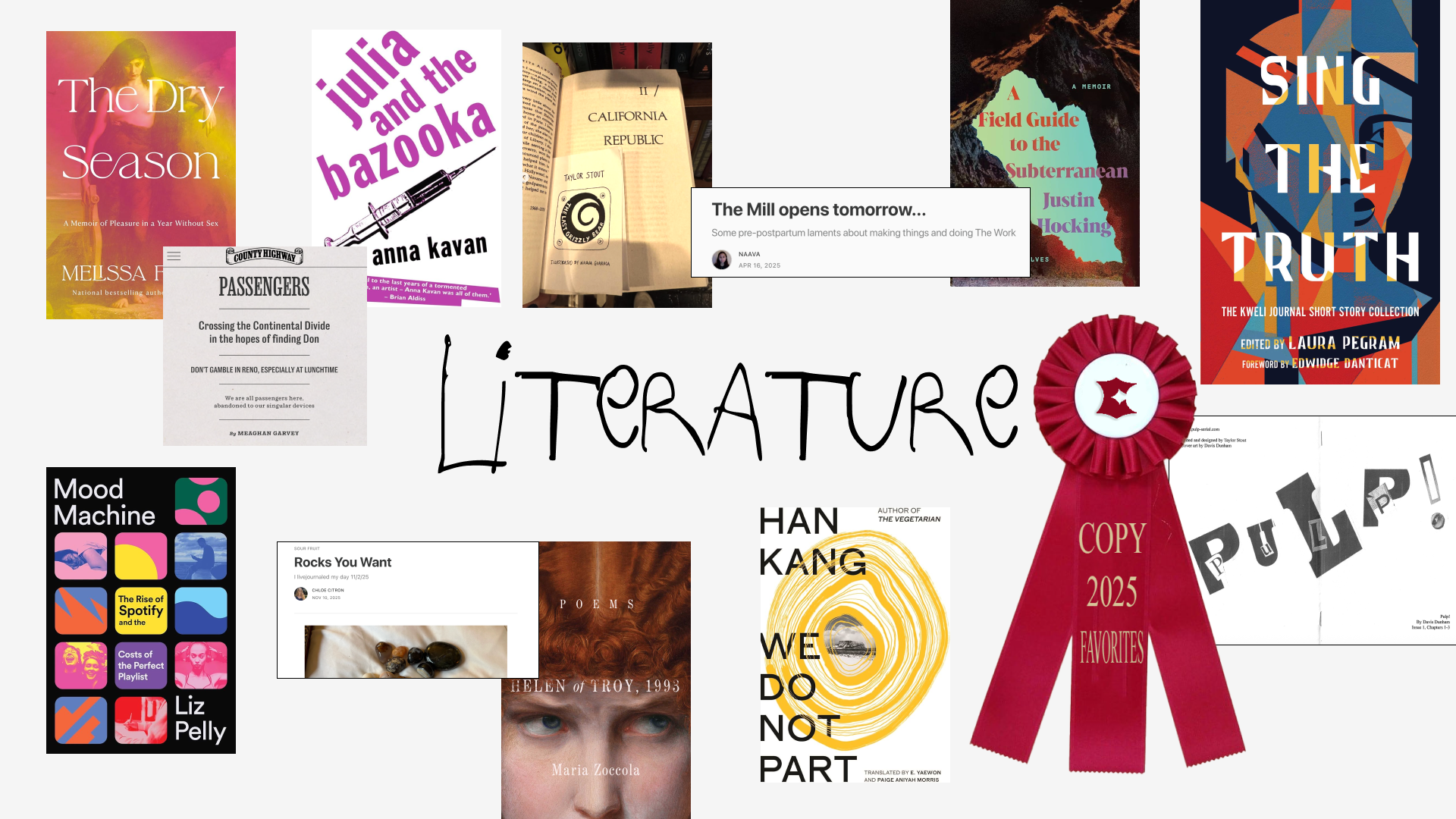
Julie and the Bazooka by Anna Kavan
Introduced to me by my friend Hanna from Berlin, I dove headfirst into the dangerous world of Anna Kavan. A literary figure so evasive and obscure that every biography written about her is brimming with inconsistencies and erroneous oscillations, she remains one of the biggest mysteries of 20th century authors! A surreal, oneiric, monadic presence who pulls you into her world that even she does not have a grasp on. A fantastic read for anyone who dares to read not in the hope of finding themselves but of completely losing their idea of identity and what masterful craftsmanship can look like.
Taylor S
My friends’ writing
I only read one book that came out this year, not a large enough sample size to pick a “favorite.” While the books I read veered older, that’s not to say I was only pulling from dusty shelves—I spent much of 2025 with the work of my friends, and these are the works that really defined my year. The day before our gallery show opened in April, Naava wrote this Substack post about her “pre-postpartum” feelings that made me teary-eyed and articulated the gravity I felt in that moment. Her words still echo in my head. I spent the summer assisting Davis with his serialized detective novel, Pulp!, which we printed and stapled and packaged together while watching Patrick Swayze movies with his cat Teddy, and which he mailed out biweekly to almost a hundred people. Mia produced a plethora of one-pager zines this year, stories of crushing and longing and watching your friends fall in love—she even started a truly micro press, pocket publications. I’ve been editing Adam’s forthcoming project about his favorite songs of the past five years, and I can feel his heart through his words in the shared Google Doc. Daryl and I exchanged some lengthy and rambling email letters, thinking through capitalism and rock collections and family history, and these notifications lit up my eyes when they lit up my phone screen. Some of my favorite sentences I wrote this year, I wrote in response to her words.
This is all a reminder that literature is not some cloistered and mysterious thing out of our reach. It’s fueled by the same conversations and love that fuel our daily lives.
Amelia L
“Passengers” by Meaghan Garvey in County Highway
What I love about Meaghan’s writing is that she’s not merely an observer or a voyeur, she’s an active participant in her stories. In “Passengers,” she boards the California Zephyr train hurtling west from Chicago, drinking and chatting with fellow riders. The care and attention Meaghan pays to each person she meets lifts them out of the text and into reality. They are more than characters; they are individuals with their own struggles and wishes and triumphs and failures. In a society that fetishizes “main character energy,” relegating others to “NPCs” or “background characters,” Meaghan doesn’t just drop the passengers she meets on the Zephyr conveniently into her narrative. She sees them.
Amelia O
Lonely Crowds by Stephanie Wambugu
A possible thesis of Stephanie Wambugu’s Lonely Crowds resides on the first page: When I met Maria, I learned that without an obsession life was impossible to live. Our narrator Ruth’s life collides with Maria’s in fourth grade, when they are the only two Black girls at a Catholic school in Rhode Island, and continues to intertwine with it through college at Bard and into the New York art world in the 1990s. As is true of many masterful first-person coming-of-age novels, one feels the pain of adolescence in step with the narrator. In Lonely Crowds, this pain is one of radical devotion. For Ruth, the world revolves around fearless Maria. The strength of the book lies here, in Wambugu’s illustration of their relationship’s complexities and limitless depth. With confidence and authority, Wambugu discusses and explores upward mobility, sex and sexuality, an artist’s life, organized religion’s impact on childhood and identity, being Black in predominantly white academic spaces, and marriage.
Henry T
We Do Not Part by Han Kang
Years ago, Han Kang imagined a snowy forest, with trees bending about in ways that can only be described as human. Her novel We Do Not Part, which was translated and published in English for the first time this year, began with that vision. During her writing process, Kang considered three questions: To what extent can we love? Where is our limit? To what degree must we love in order to remain human to the end? The resulting novel is a winding, harrowing descent into the ghostly echoes of political violence. A book for winter if there ever was one.
Philip K
Helen of Troy, 1993 by Maria Zoccola
What if Helen of Troy were a woman living in 1990s Tennessee? What if the Greek chorus that surrounded her only spoke in crown sonnets? “if you never owned a bone-sharp biography,” the book starts, “i don’t want to hear it.” The titular Helen is a sharp-fanged speaker, bursting with discontent, desire, and rancour. Zoccola’s book is persona and narrative poetry at its finest. The poems that populate this deft collection overflow with delicious speculation. I recommend it for any appreciators of poetry and Greek mythology heads.
Mickey G
More friends’ writing
Similarly to Taylor, I found joy and presence in the words of those in my circle. My short-form, algorithm-riddled brain was able to encounter some kind of freedom in these moments.
Amelia Olsen’s Letters of Rec guided me to some truly incredible picks, including Health and Safety and On the Calculation of Volume. Feeling confident in the recs of a good friend, I put these books on hold at the library and always had something to turn to when I wanted to get off of my phone.
Chloe Citron’s Substack, particularly her live journals, has been a beautiful excuse to slow down. Chloe’s keen observations and dry humor often stop me in my tracks:
“I used to think of magic and adventure as a destination that I would reach when I was old enough. Now of course I look back and see that these things have been threaded throughout my life, instead of being a portal I got to step through.”
- “Rocks You Want” by Chloe Citron
Naava G
A Field Guide to the Subterranean by Justin Hocking
God bless the New York Public Library! I devoured this book in a day when I did little else but read it. Hocking explores excavation of the self alongside excavation of the earth. It’s a beautiful memoir I literally couldn’t put down.
Lily C
Mood Machine: The Rise of Spotify and the Costs of the Perfect Playlist by Liz Pelly
This book made me angry and it was so, so good. Incredibly well-researched and engaging.
JoliAmour D
“Work” by DéLana Robinson, featured in Kweli Journal’s anthology, Sing the Truth
What’s with me, why am I crying? Was it about her love for music? Or the bond shown between this protagonist and her older janitor friend? Is that why I’m so emotional? Was it the CDs he let her borrow? The lyrics she learned? Why did I laugh at those first pages about friendship bracelet businesses? Was it because I, too, sold rainbow loom bracelets in seventh grade for $1?
Why do I keep nodding? A real spiritual hum leaving my throat (as when you go to an open mic or a slam poetry night and everyone starts snapping)—what’s wrong with me? Or what’s right with me? My answer revealed itself by the ending, when the protagonist cried in front of Tony, sobbing that “people just take-take from you.”
The author captures more than just child-innocence and budding capitalism. “Work” describes the transactional nature of some of our closest relationships, and the true love of remembrance. When people remember to love you, as is. I rubbed my thumb over her words like they were a memory. Because in some ways they are.
Theodora L
The Dry Season by Melissa Febos
Her writing is always vulnerable, but never salacious. Her life and past are shocking, but she never submits to that narrative. Instead, she makes her own, creating a story out of her interest in stories, writing from her interest in writing, living from her interest in the lives of others. I didn't know that I could say no. I didn't know that I could say yes. I didn't know that I could say either no or yes.