PRINT
WRITINGS
The Things They Bought #1
Curator Spotlight: Victoria Campa
OPERFORMANCEF Interview
On Art and Aliens
Caroline Strickland at Union Pool
Remembering Who We Are
Painting in Defense of Life
Ask Casey: A New Advice Column
Archive
COMMUNITY BOARDS
Music
Literature
ABOUT
@READCOPY.CO
WRITINGS
The Things They Bought #1
Curator Spotlight: Victoria Campa
OPERFORMANCEF Interview
On Art and Aliens
Caroline Strickland at Union Pool
Remembering Who We Are
Painting in Defense of Life
Ask Casey: A New Advice Column
Archive
COMMUNITY BOARDS
Music
Film
Visual Art
LiteratureABOUT
SUBMIT
DONATE
@READCOPY.CO

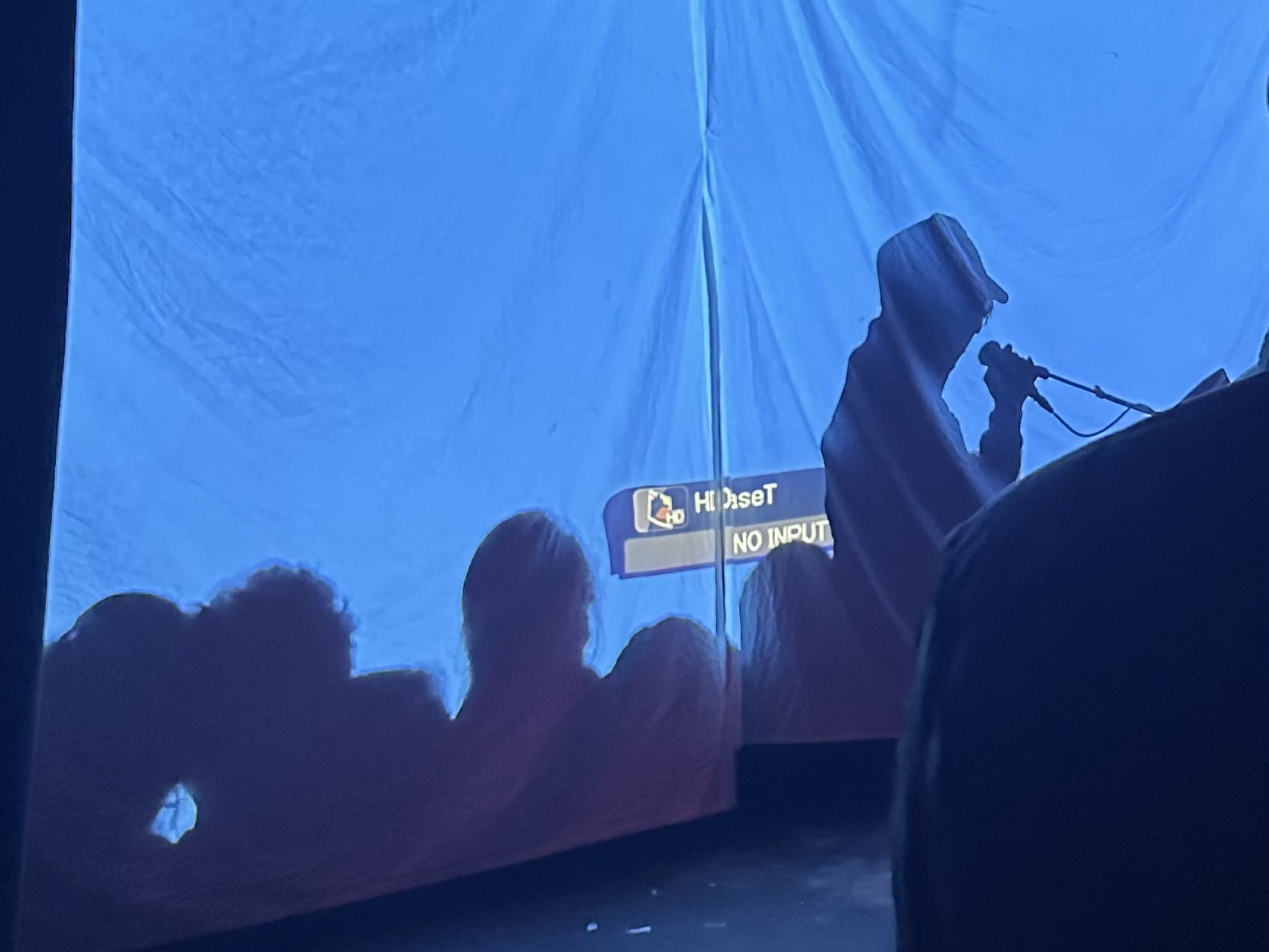
Photo by Lizzie Racklin.
Who the Fuck Is Chet Chomsky?
Under an alias, The frontman of America’s most exciting young rock band plays TV Eye.
By Taylor Stout
1.25.2025
“Everything is lying.”
- Cameron Winter, “Drinking Age”
***
“Is she comfortable going sort of incognito?” an event organizer asked Lily (my concertgoing buddy, and the wizard behind the curtain of our DIY arts publication’s Instagram DMs) after she told them I’d be happy to review their upcoming show at TV Eye in Ridgewood, Queens.
I immediately told Lily I was down. I had never received a request like this before. I am not a niche celebrity—what would it even mean for me to be incognito if no one recognized me in the first place? But I could empathize with the desire for a low-key, non-sceney environment. “I’ll wear a fake mustache,” I teased.
You see, the organizer had told us a secret artist was set to perform at this show: a buzzy young crooner who had skyrocketed to fame in the past year, perhaps a bonafide generational talent, one whose name suits January’s gray skies and the steady snowfall that filled the weekend leading up to his performance. This embargoed intel wasn’t anywhere on the poster, of course, and Lily and I were hesitant to get our hopes up. But alongside Googleable acts Emily Green, Leo Paterniti, Fantasy of a Broken Heart, and @ (yes, pronounced “at”) appeared the name “Chet Chomsky,” an artist the event promotion described as a “newly discovered southwestern master of song” who would be “flying in all the way from Tucson, Arizona.” Kind of believable, I guess—or was it? When I plugged the name into my search engine, this TV Eye show was pretty much the only thing that came up. Turns out all you have to do to avoid that pestering Google AI summary is to search for someone who simply does not exist.
Nonetheless, the myth of Chet Chomsky evoked a romanticized past of unknown drifters wandering from desolate lands and into dingy venues, then making everyone’s brains explode with insights like, “The slow one now will later be fast, as the present now will later be past” (Dylan), or, “Blessed are the meek, for they will inherit the earth” (Christ). For all of human history, the unassuming prophet has held an enrapturing pull. I was curious what this artist would have to say.
And if his name was indeed an alias, I had questions: what parts of his identity were rooted in reality, and what were forged for fun? Any relation to Noam? Most pressingly, why does Chet’s creator feel compelled to occupy this twangy, alliterative character, of all the beings one could invent? As I would be going to the show incognito, I couldn’t interview the elusive artist himself. But I could brave the cold and dark, hop on a bus to Ridgewood, and be present in the room where his performance would unfold. In place of a face-to-face dialogue, I could enter into artistic conversation with “Chet” by toying with the bounds of my own obscured identity: putting on the character of “incognito journalist” and acting more mysterious (or flirtatious? or belligerent?) than usual. Plus, there was the latent aspiration of any serial concertgoer: the chance that I might witness musicmaking moving enough to remind me that I am indeed real, specific, and alive.
***
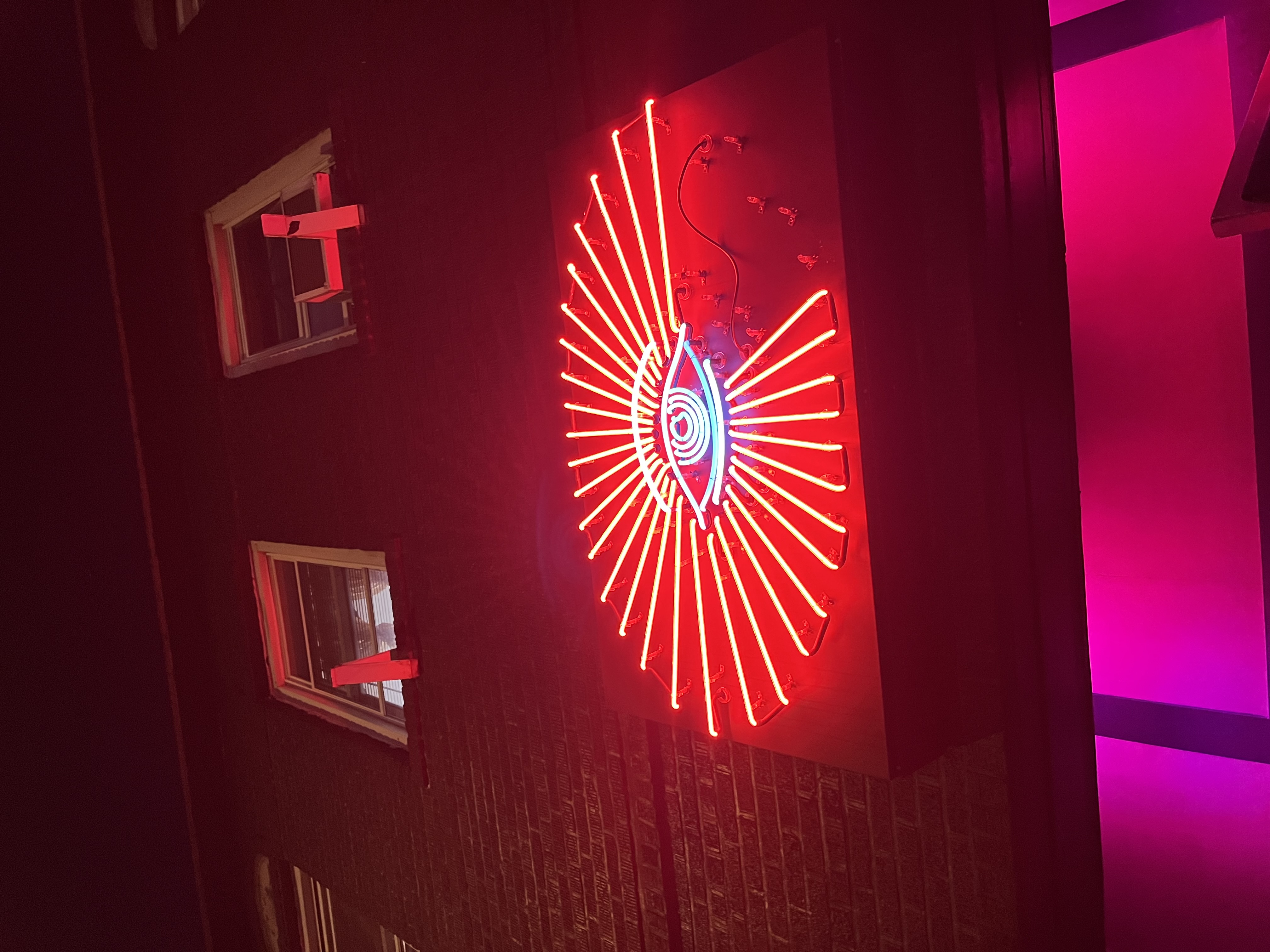
“I feel electric,” I texted the friends I was about to meet up with at TV Eye before heading out the door. I walked through the dark and empty streets while listening to old Rihanna. My bus stop on a relatively random residential intersection was populated by young people with trendy haircuts—bangs and shags—and I bet to myself they were going to TV Eye too. I sensed my destination’s magnetic pull. These people did, in fact, exit the bus alongside me, and we walked down the icy block to the venue’s facade, marked by a neon-lit eye blinking in the dark.
Photos by Taylor Stout
Inside, I found Lily, and she told me our mutual friends were there—they didn’t have tickets, but their college friend was working sound, so they were taking a leap of faith. Shortly after, one of them came up to us. We hugged and he flashed a wristband at me: “We just finessed these.” Then, “I hear you’re writing tonight.”
“I’m incognito,” I divulged to him excitedly, and to everyone else. So much for mystery.
“Where’s your fake mustache?” asked Lily.
We were standing by the bar when a hooded figure slipped in through the front door. It was him, “Chet Chomsky”—legally and more widely known as Cameron Winter. Cameron Winter, the Brooklyn kid who founded the band Geese with his high school classmates, releasing their debut album at age eighteen. Geese, the band that GQ recently declared “America’s Most Thrilling Young Rock Band.” Geese’s first two albums were well-received and exciting, but 2025 was a landmark year for Winter: at the tail-end of 2024, he released his debut solo LP Heavy Metal and swiftly rose to cult stardom. In February, an UPROXX headline declared, “It’s a Cameron Winter Winter,” and in May, i-D published an interview with him titled, “Cameron Winter Summer.” This was all followed by the September release of Geese’s third album, Getting Killed, which only cranked up the hype’s volume. As the year wound down, Pitchfork named Winter’s “Love Takes Miles,” the warmest and most pop-forward track on Heavy Metal, the best song of 2025.
Going into this covert TV Eye show, Winter—now twenty-three—was fresh off a sold-out solo show at Carnegie Hall in December. I hadn’t been there, but I’d seen pictures: it was just him and his piano on the hallowed and gleaming stage, with his back to the crowd and director Paul Thomas Anderson leaning over him periodically with a movie camera, documenting music history.
Winter loomed in the dimly lit room where we stood, his dark and moody eyes cast downward and shrouded in a shag of brown hair that stuck out from under his gray hoodie. A sea of people parted and swirled around him, noticing his presence and then playing it cool.
As we made our way into the performance space, Lily said, “I’ve never seen a more punctual crowd for a TV Eye show.” The place was stuffed to the gills, and it was only about 7:30 PM. We were heading into the first of a staggering five sets. Typically, when I’m seeing an opening act at a smaller venue, I can stand wherever I want and move about the room freely. In TV Eye, we were pinned toward the back. Clearly, this wasn’t a typical night.
First up was Emily Green, Winter’s own Geese bandmate. She played works in progress, or as she called them, “what’s under the hood,” admitting: “Usually, what’s under the hood is dusty as hell.” The performance did feel raw, in a compelling way. I could envision Green tinkering with instruments and jotting down lyrics in a notebook in her room or garage. It was a stark and welcome contrast to the tight and invigorating guitar that Green brings to the average Geese track.
“Is everyone excited to see Chet Chomsky in like three hours,” Green muttered between songs. “He came all the way from New Mexico—”
“Arizona!” a guy in the crowd shouted.
“Fuck,” said Green. “That part of the country gets hazy for me.” Yep, these are New York City kids, I thought: born and raised in the dead center of civilization’s twisting gyre.
My friends and I spent the first half of the night drifting in and out of the performance space, not wanting to be stuck standing in one place for too long for the sake of our backs and knees as well as our mental stimulation. We dipped back into the room to catch some songs from act number two, Leo Paterniti, which were upbeat and pleasant, like something I’d want to listen to while lightly high on a summer day, though we couldn’t see the stage or move much at all. Tension was building; Winter’s devotees were already staking their claims to floor space.
One of us suggested that maybe the people who didn’t know Chet Chomsky was Cameron Winter would leave before the end of the night.
“Everyone knows,” the rest of us replied at once.
(While there had been excited whispers coursing through the air all night, this declaration would turn out to be false: my friend Lizzie reported to me that the person behind her had said they were there to catch another band’s set, and was only convinced by their neighbors in the crowd that Chet Chomsky would be worth staying for. The next morning, Lily texted us a screenshot of a Reddit post where someone said they decided to stick around for the last act because why not and then their jaw dropped when they realized what they were in for the moment the curtains parted. I am so happy for these people. In their shoes, I might’ve cried. I almost did anyway.)
After swaying to Leo Paterniti, we exited the performance space for one last breath of fresh air before the real work of hunkering down for Winter began. We got chicken sandwiches and fries from the venue’s kitchen and conversed about nothing in particular while an unspoken current of anticipation ran between us. I was just as daunted as I was excited: we still had two more sets to go before the headliner, and I wasn’t entirely sure we’d be able to fit back in that room.
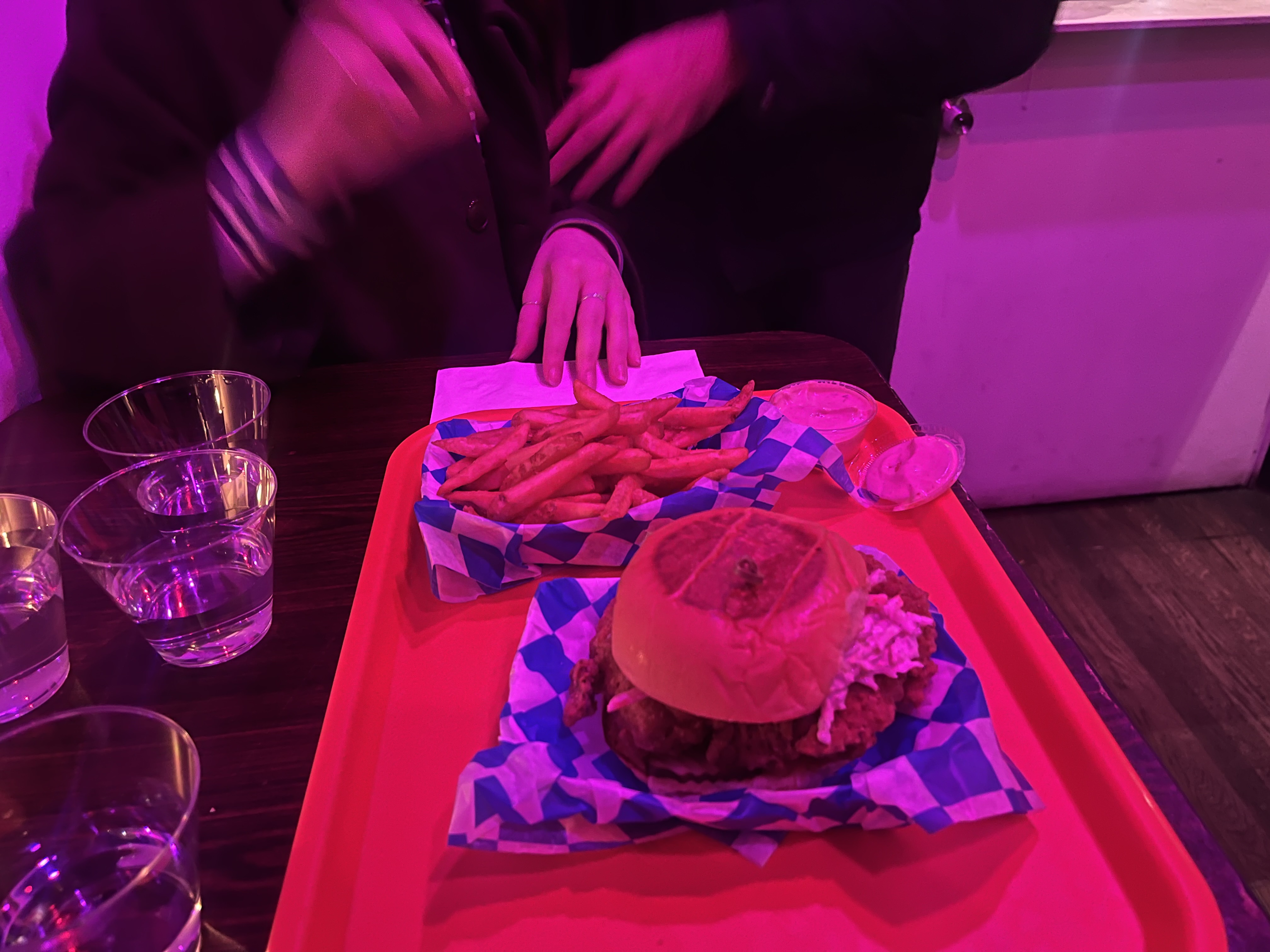
Photo by Taylor Stout
But we were determined. At first, we crammed ourselves into the propped-open doorway. Fantasy of a Broken Heart had taken the stage. I spotted Winter just a few people away from us in the crowd. His hood was off now, but he was still gazing solemnly ahead through his shaggy bangs, nursing a milky-looking drink. In the space between two songs, Lily dove into the belly of the beast and I followed the path she carved, our other friends in tow. We swam right past him.
With a more sustainable position in the packed room, I turned my focus to the stage. The barely concealed ruse of “Chet Chomsky” persisted, with a band member telling the crowd (at least, this is how I heard it) that we would later be “treated to the tropical stylings of chimpanzee.” Fantasy of a Broken Heart played artsy indie rock songs that made me understand why a hook is called a hook—their melodies grabbed me and pulled me into the music. I couldn’t resist bopping around. While I knew I could come up with words to say about the preceding acts and about any number of fun-enough indie shows I’ve attended over my years in New York City, this was music I didn’t have to think about why I liked; it just felt good, and that was everything. I thought of the E. E. Cummings poem: “since feeling is first / who pays any attention / to the syntax of things / will never wholly kiss you.” I leaned into the feeling.
After their set ended, the crowd shifted. We used this movement to weave our way closer to the stage, hoping that maybe we would be able to see something, anything, beyond the occasional bobbing head. This was a particularly tall crowd, and several people were wearing bulky hats that reminded me of those donned by Russian fur trappers. We scooted forward and then scooted forward some more. We eventually found a tight stretch of open space and lined up one-by-one against the room’s left wall, right by the emergency exit doors closest to the stage. There were only a few rows of people in front of us. The crowd was packing in tighter and tighter, and despite all the fun of putting on an incognito journalist persona, I felt the bounds of my real and specific aliveness closing in on me.
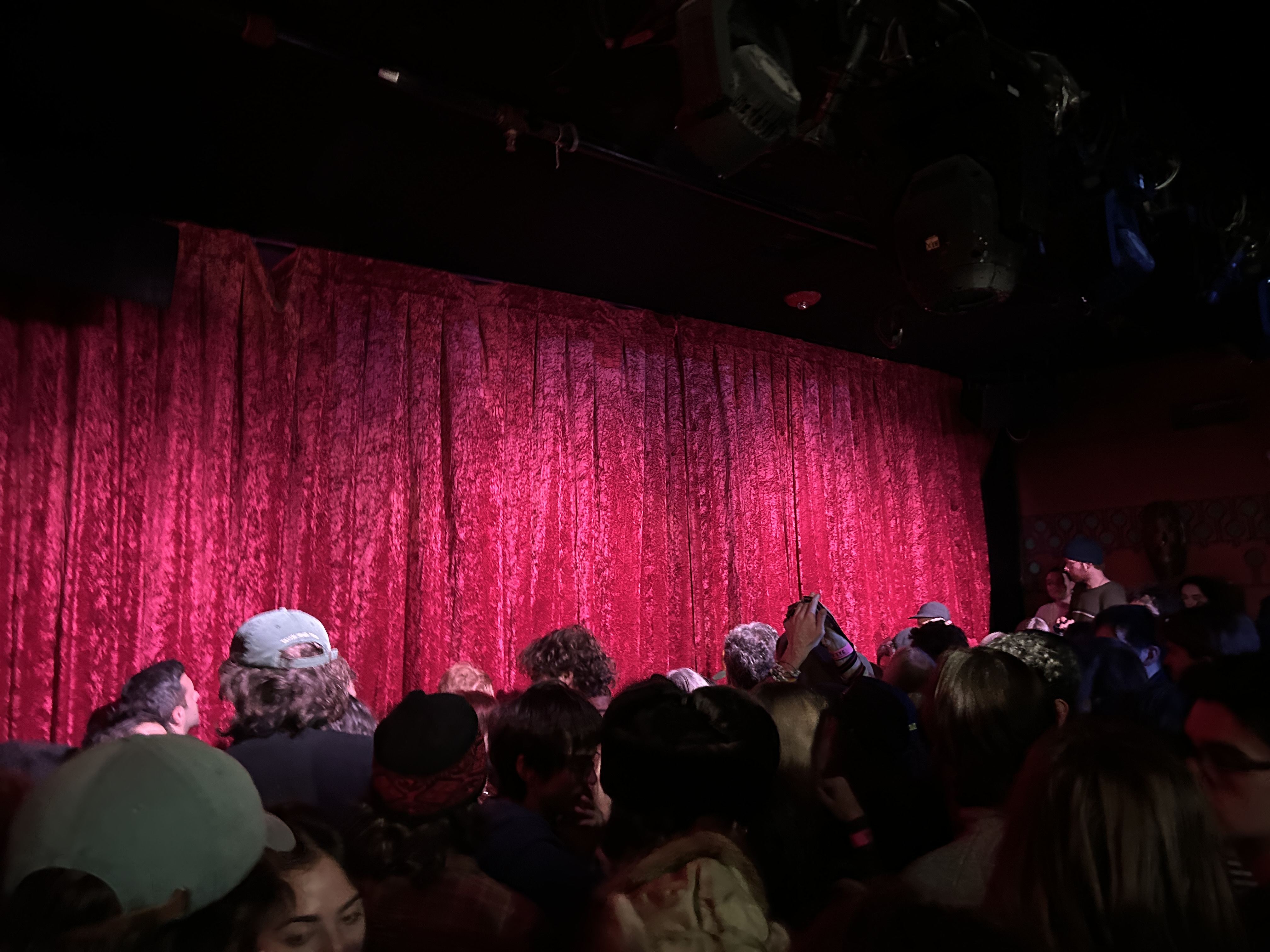
Photo by Lily Crandall
I leaned my back against the wall to ground myself against something solid. I had to remind myself to breathe. I inhaled for five seconds, held my breath for a few, then got distracted and lost track, then tried the breathing exercise again. I closed my eyes and tried to imagine there wasn’t a seemingly impenetrable sea of people between me and the open air outside. I hoped I didn’t look crazy. Lily offered us all sticks of gum and I took one hoping the sharp taste would ground me via physical sensation, which actually sort of worked. Everyone I could see in front of me was gossiping and smiling. I felt like an alien trying to be human, chewing my spearmint gum for dear life.
Pressed against the wall, I turned to Lily and said, “Isn’t it crazy how the reason this wall stays solid is because molecules are sticking together?” which is definitely something a fine and normal person would say. But she laughed and was like, “I know right!” and told me about her high school science class.
When the band @ finally took the stage, it was a remedy. Their ethereal songs paired cello and flute with the lead singer’s melodic, fairy-like voice conjuring meadowlands and crystalline streams. As she sang, it had a similar effect to when someone brushes my hair or holds my hand. I felt cared for and could somewhat calm down. Plus, I’d made it this far, and I had an important mission. By the time the set ended, my terror-anxiety had transformed into excitement-anxiety: still a tense feeling, but one that can be energizing rather than destructive. The secret would soon be revealed. I don’t remember what my friends and I talked about, if anything, before the lights once again dimmed. But soon enough, the chattering room went dark.
***
How do I describe this next part without taking on the fervor of a born-again tent revivalist and risking your trust in me, reader? In the first moment Cameron Winter emitted sound from his mouth, I felt as if a faith healer had held their hands an inch above my skin and cast the very devil out of me. The opening number wasn’t even a song of his I’d heard before, it was something new. The lyrics were impenetrable and direct in a way that felt ancient, akin to Genesis. “It all fell in the river / And very easily passed / And what didn't fall in the river / I abandoned on the grass,” he sang, his baritone resonating, making the body-heated air vibrate. “It all fell in the river and the tears fell at last.”
When the song ended, I turned to Lily and her boyfriend Charlie, my face contorted with awe, and went, “WHAT?” Lily laughed. Charlie just nodded, solemn.
“This is Chet Chomsky,” mumbled Winter, at which the crowd chuckled. “I’m from Tucson… I’m very nervous… if you could all be generous… my crippling stage fright… and my chequered past… are weighing very much on me tonight.”
He was being funny, but I could feel a kernel of truth in his introduction. On stage, Winter sat at a piano, shrouded in that gray hoodie again pulled far over his head. The Arizona roots and “chequered past” may be a self-made mythos for this Park Slope-born son of a self-help author, but perhaps there was something to the nerves and “crippling stage fright.” I thought of Winter’s propensity to perform with his back to the crowd, as he was doing now from where I stood. I didn’t see his face at all; I could barely catch glimpses of his concealed, hunched-over form when I shifted onto my tip-toes to see over the guys in front of me. And not only did Winter face away from us, but the stage lights stayed off for most of the set, save the occasional glow of a blue “NO INPUT DETECTED” screen projected over him. The undulating psychedelic backdrops that had illuminated the other bands were absent.
But I didn’t feel any of this as a lack. It seemed that Winter wanted to be partially hidden so that he could reveal himself to us in other ways. I was more than content just to listen to his voice. The darkness had a velvety quality that made the world fall away.
Winter’s self-concealment, his caricaturization of what may have started as a real fear, made me realize what our aliases and personas were for. By obscuring factual parts of ourselves—our everyday identities, our faces—we can more readily reveal our emotionally true parts. It reminded me of that pivotal scene in Paris, Texas, when ex-lovers Travis and Jane sit on opposite sides of one-way glass, and even though Jane can only see her own reflection, Travis still has to turn away from her before he can tell her his story of their relationship and its dissolution. It made me think of the Wolfgang Tillmans portrait gracing the cover of Frank Ocean’s Blonde, how on an album that still stands a decade later as one of the most emotional and fluid works I have ever experienced, the artist is hiding his face from us; further, the bandage wrapping Ocean’s pointer finger betrays a wound, a sensitivity, that he has likewise concealed from the world in order to heal. I thought of how, while relaying childhood memories to my therapist, I always gaze up at the far corner of the ceiling rather than looking into the face of the person I’m addressing. I don’t know if I could get the words out if I had to meet her eyes the whole time.
Beyond his transcendent voice and fluttering piano melodies, the delicate balance of the comedic and the unrelentingly earnest lies at the heart of Cameron Winter’s singular appeal. He is a prophet for our age of disenchantment and disconnection, where so much seems (or literally is) artificial. When we are immersed in and accustomed to this artifice, we become too out of touch with our own feelings to ask for the connection we crave. Winter’s sly humor is like the self-soothing laugh someone lets out when they finish telling a sad story: it reveals in its attempt to conceal, and we recognize ourselves in it. It offers us a way into his world of emotion that is at once devotional and devastated. I’ve always thought of myself as a person full of longing, but over one year after I first heard it, I’m still blushing at the “Love Takes Miles” line, “I need your feet more than you do.”
Winter closed his set with the Heavy Metal track “$0,” which starts as a dizzy lament and ends in religious fanaticism that expertly falters between totally serious and totally not. Winter repeats over and over that “God is real,” stretching out the word “God” so long it seems to wrap around the whole world and touch every part of you and every part of everything you’ve ever touched, and isn’t that how the believers say it really is? He punctuates this repeated line with maniacal mutterings of “I wouldn’t joke about this” and “I’m not kidding this time.” There is humor and tragedy and equal measure contained in these ramblings.
By the time the vocals ceased with this ecstatic note, the song still had two minutes left. Winter gingerly played the piano, the volume ebbing and flowing. I know this is the cliched verb for piano-playing but he really did make the keys twinkle, and what is language but the valiant effort and inevitable failure to express the ineffable? It was a twinkling, I swear, I could feel the sparkles inside my skull.
Then, silence. One second, two seconds. No one started clapping. No one spoke. Three seconds. No one looked away from the stage. I could hear everyone breathing; among the gentle wooshes of air entering and leaving our lungs, I even thought I could somehow hear the stillness created by those of us holding their breaths. I had never been in a crowd so quiet.
But Winter clicked a jarring electronic note—something like an alarm, which he’d toyed with earlier in the set and which had then shocked us too, disrupting the classical beauty of his piano and operatic voice with grating artifice, thereby only heightening his music’s richness—and released us from his spell.
***
The event I write about above was a benefit concert with proceeds going to the Olive Grove Initiative, a mutual aid collective distributing funds to Palestinian families in Gaza facing displacement and colonial violence. Learn more and donate here or follow along on Instagram at @olivegroveinitiative.
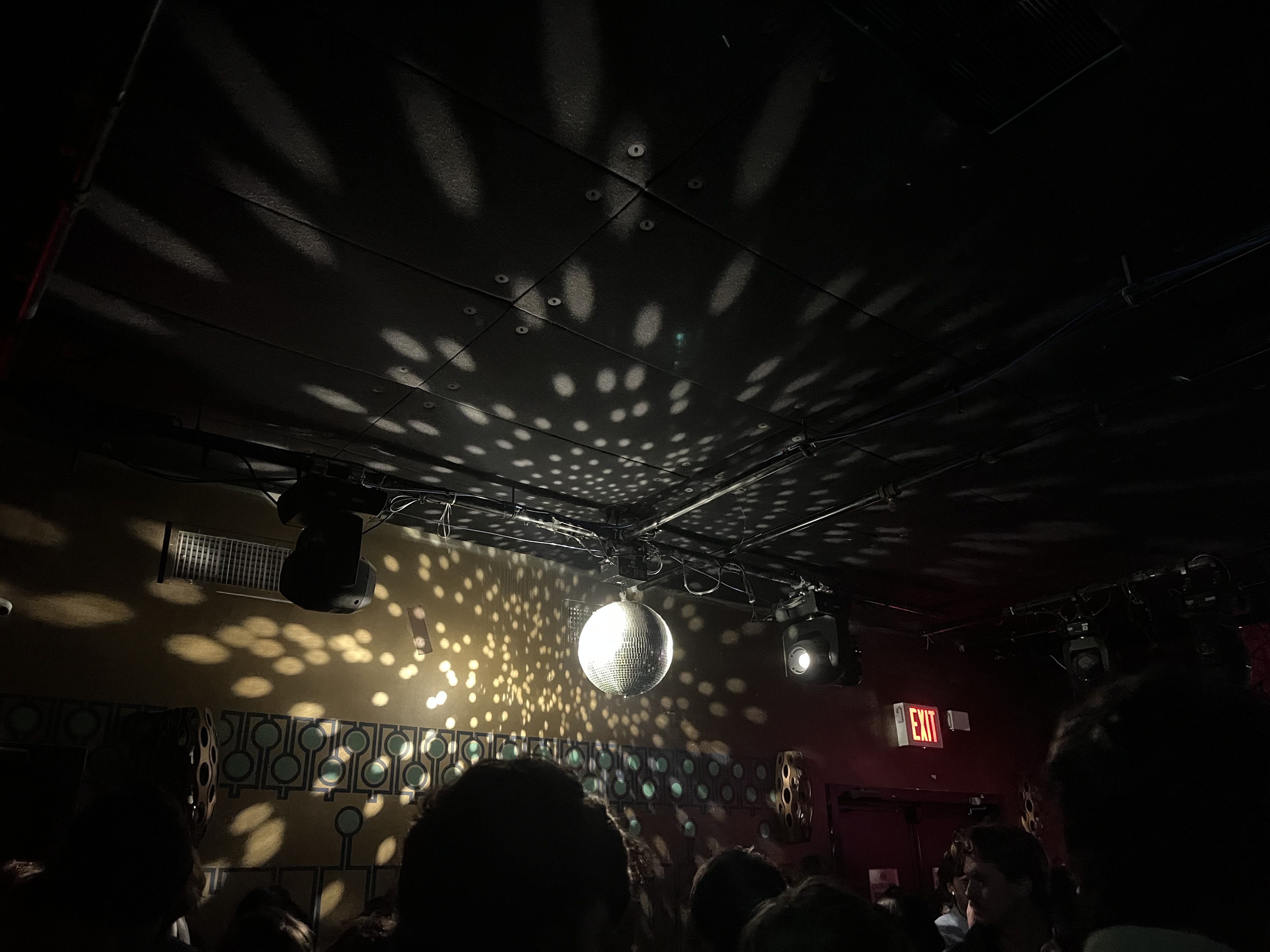
Photo by Taylor Stout